Posted by: Andy Bystrom | December 13, 2011

ARCAE begins field work in Southern Golfo Dulce

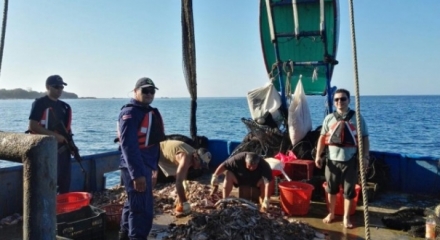
On December 10, 2011 the Costa Rican Environmental and Educational Network—ARCAE began field work for its coastal conservation project titled: Sea Turtle Activity in an Approved Aquaculture Site, Mouth of the Golfo Dulce, Costa Rica.  Organization members performed an initial visual survey of the project site aboard a local artisanal fishing boat while GPS logging the positions of all observed marine fauna therein.  In addition to the on-the-water observations, the research team is performing nightly beach patrols and has to date GPS located 3 aborted endangered green sea turtle (Chelonia mydas) nesting sites and 1 successful critically endangered hawksbill (Eretmochelys imbricata) nesting event along the area’s beaches. 

Because there is little information regarding green and hawksbill turtles for this part of Costa Rica, the ARCAE team will use the data to construct a series of maps that illustrate the occurrence of these two species of reptiles (in addition to other observed marine species) during Costa Rica’s dry season (December-April) in and around an approved yellow fin tuna aquaculture site.

Commercial tuna aquaculture threatens populations of endangered sea turtles, conflicts with Costa Rica’s commitment to protecting turtle populations, and has the local eco-tourism and artisanal fishing sectors concerned over its possible effects on the economy.  For this reason, it is the project team’s goal to contribute to the responsible management of the area’s marine resources by divulging the results of this study.

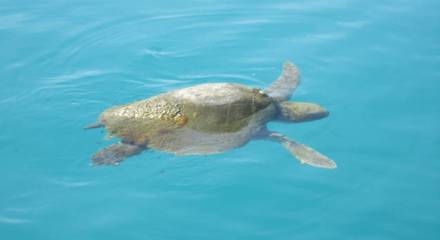
A female olive ridley sea turtle observed on December 10, 2011

UPDATE:
Thankfully, governmental approval for the tuna farm was officially terminated by the Costa Rican Environmental Secretariat (SETENA) on 7 November 2011.  While the announcement came as a relief to many interested parties, including all members of the sea turtle visual survey project, it is widely accepted that recent free trade agreements with China (August, 2011) will provide an economic catalyst for future aquaculture projects as the Asian nation is the world’s leading consumer of fish and other marine products. China’s seafood imports from Costa Rica increased 20% in 2010 and its trade agreements with Costa Rica allow for the purchase of Costa Rican farm raised tuna.

By undertaking the visual survey, the organization hopes to contribute to the local initiative to establish stronger coastal policies and management plans that promote local economic development while protecting local populations of marine fauna.  Another important project component will be a series of educational programs that increase school childrens’ knowledge and understanding of the area’s marine ecosystem.

If you would like more information on ARCAE and how you can contribute to this project’s success, please contact Andy Bystrom at a.bystrom@arcae.org

Posted by: Andy Bystrom | November 10, 2011

Tuna Farm Aquaculture Project Stopped

On Monday November 7, 2011 Costa Rica’s Environmental Secretariat (SETENA), via official document 2723-2011, stated it would no longer consider Granjas Atuneras de Golfito SA’s  petition to construct a yellow fin tuna aquaculture project, or tuna farm, at the mouth of the Golfo Dulce.  SETENA’s decision permanently closes the case on Granjas Atuneras’ (the company responsible for the project) 7 year campaign to bring industrial aquaculture to Costa Rica’s Southern Pacific coast.

Concerned Pavones Fishing Association president William Mata points out the proposed tuna farm location earlier this year (foto: Andy Bystrom)

SETENA’s decision to stop the tuna farms was based on an existing Supreme Court order against the project, the company’s apparent falsification of information in its environmental impact assessment, and the expiration of project permission granted by SETENA in 2004 and in 2008, among other factors.

“So many people worked to stop the tuna farms: Golfo Dulce residents, the Pavones No Tuna Farms Association (ANAGA), the international surfing community, national and international NGOs, attorneys, and many more,” said Andy Bystom, a Pretoma consultant.  “On behalf of everyone involved, we’d like to applaud SETENA’s decision to stop this project.”

Approval of the project would have meant the installment of up to 80 circular tuna cages located 1 km off the coast of some of Costa Rica’s most important sea turtle nesting beaches.  Tuna aquaculture would have also been a major contributor to biological waste that could have potentially degraded water quality along economically important surfing and ecotourism areas, as well as negatively impacted local fish stocks.

One caveat in the tuna farms episode relates to recent free trade agreements between Costa Rica and China that allow for the commercialization of farm raised tuna.  Because of these new economic relationships, more industrial aquaculture projects could be proposed in the near future.  “For this reason, it’s imperative we continue to gather information on the importance of maintaining the environmental integrity of our coasts both for the economic development of local communities and for the protection of endangered species,” said Bystrom.

Posted by: Andy Bystrom | September 15, 2011

You self righteous jackass. You’re pathetic.


Picture: google images

A while back I posted some “hate mail” I received regarding the proposed destruction of Leatherback Sea Turtle National Park here in Costa Rica.  Because doing that was so therapeutic, I thought I’d post the following public comments I got from a gentleman who wants to know where he can see whales and play golf down here.  You can view the comment thread here.  Enjoy:

patrick ritchen
69.198.36.174 Submitted on 2011/09/08 at 1:07 pm
What are the most common ports where whale watching boats leave from in February? l’m trying to co ordinate a fishing and whale watching trip (as well as golf). If you can give me several ports which have all those nearby I’d be very grateful. Pat Ritchen

Andy Bystrom
costaricanconservationnetwork.wordpress.com
abystrom1@yahoo.com
201.198.6.234 Submitted on 2011/09/11 at 6:29 pm | In reply to patrick ritchen.
Feb isn’t the best month to see whales in CR. Humpbacks are here right now! But try Bahia Drake on the Osa Peninsula and hotels around the Parque Nacional Marino Ballena (whale national park) in Central CR. Sorry, I can’t help you with the golf as golf cources are a major contributor to the destruction of coastal zones. I’m guessing there’s pleanty of golf in your home country—leave the clubs at home and suppot true ecotourism efforts here!

patrick ritchen
69.198.36.174 Submitted on 2011/09/15 at 1:31 pm
You self righteous jackass. Golf courses don’t DESTROY the ecosystem or the delicate coastal foliage. You misspelled “course” by the way. I’m sure you’re living in a tent or a small hut with a palm frond roof. You’re pathetic. P. Ritchen

Andy Bystrom
costaricanconservationnetwork.wordpress.com
abystrom1@yahoo.com
Submitted on 2011/09/15 at 1:47 pm | In reply to patrick ritchen.
Thanks for your comments (and the spell check) Patrick. I actually live in an apartment in San Jose (2 million people) and often wear a suit and tie when I lecture. Yes, we walk among you!
Andy

Posted by: Andy Bystrom | August 25, 2011

PRETOMA—finalist for 2011 Gulfstream Navigator Award

English translation of press release sent to Costa Rican media 

“The Sustainable Coastal Development Project,” implemented in the district of Bejuco, Guanacaste by the Costa Rican environmental non-profit PRETOMA, has been nominated as a finalist for the 2011 Savannah Ocean Exchange’s $100,000 Gulfstream Navigator Award.  Each year the Savannah Ocean Exchange (September 7-8, 2011 in Savannah, Georgia) brings together international leaders to learn about the top world-class “Solutions Inspiring Action.”   The Exchange’s 2011 theme is “Shaping the Future of Our Coasts” and will highlight fourteen ideas from around the world that offer practical solutions to development problems facing our coasts.

PRETOMA’s solution is a sustainable coastal development plan that creates sustainable production methods and responsible consumption strategies between artisanal fishers and hotel operators.  The non-profit, along with the Association of Coyote Fishers (ASPECOY) and the Association of Bejuco Fishers (ASOBEJUCO), is identifying sustainable snapper fishing techniques and creating locally based markets that facilitate snapper sales between fisher folk and area hotels.

ASPECOY fisher folk leaving for a night of snapper fishing

 “The project is creating coastal resource protection initiatives made possible through socioeconomic development,” said Andy Bystrom, the project’s designer and PRETOMA consultant.  “Because of this, we hope that increased fisher profits garnered through the direct sale of sustainable snappers to local hotels will be the incentive needed for these associations to conserve fisheries resource for future generations to enjoy,” continued Bystrom who will be speaking at the Exchange’s event in Savannah.

Another key project ingredient is marine protected area (MPA) development to conserve coastal fish stocks, an important component in the socioeconomic development of thousands of artisanal fishers in Costa Rica.  For this reason PRETOMA, along with ASPECOY and ASOBEJUCO members, is lobbying for more coastal MPA development.

The project team has applied for a Marine Stewardship Council (MSC) sustainability certification and in May underwent an MSC pre assessment by an accredited third party certifier.  If successful, the project will be the first MSC certified fishery in Central America.  PRETOMA also plans to replicate the project’s methodology to other fishing and tourism communities in Costa Rica and Central America.

The project is a winner of the 2010 National Geographic and Ashoka Changemakers Geotourism Challenge.  PRETOMA would like to thank the project’s gracious sponsors: Conservation International, WSPA, Whitley Fund for Nature, Sea Turtle Restoration Project, Resources Legacy Fund, BBC London.

For more information:
Andy Bystrom
andy@pretoma.org

Posted by: Andy Bystrom | August 16, 2011

The sustainable seafood economy–it’s happening

Bottom longline snapper fishers (picture: Erick Lopez)

Our coasts are on the edge.  With a global race being run to exploit coastal resources, we push these areas of economic, environmental, and social importance closer to the tipping point.  Assuming these pressures will not subside in the foreseeable future, we must begin to identify and implement sustainable development strategies for the planet’s coastal areas if we’re to continue to enjoy the treasures they bring to society.  One small piece of the puzzle is the creation of sustainable production methods and responsible consumption strategies.

In Costa Rica fishers are using sustainable techniques to catch snappers.  They then sell these snappers to local hotels whose guests are encouraged to participate in the purchase and consumption of a locally produced product.  The project is beginning to yield sustainable fishing strategies and a responsible tourism industry that benefit one another in environmental protection efforts and the socioeconomic development of local residents.  When replicated, the project will contribute to the sustainable development of entire coastlines.

The project is facilitating participatory management of the Southwestern Nicoya Peninsula’s coastal resources among artisanal snapper fishers and government officials through the identification of responsible fishing techniques that preserve local snapper stocks and the development of marine protected areas that allow for these techniques while prohibiting other destructive ones.

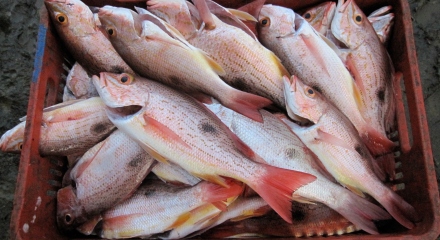
Sustainably caught spotted snappers (picture: Will Parinello)

The environmentally conscious visitor’s desire for sustainable seafood options and willingness to contribute to local development projects is then served through the direct sale of responsibly caught seafood between fishers and tourism establishments.  Local markets between fishers and tourism operators also eliminate lengthy chains of custody that result in meager earnings for primary producers (fisher folk).  Higher fisher earnings will act as incentives for locals to continue to apply their responsible fishing techniques, thus insuring will be ample resources for future generations of fisher folk to extract.

The project is being evaluated for a Marine Stewardship Council sustainability certification, and in February, 2011 project designer Andy Bystrom led a campaign that won National Geographic’s and Ashoka Changemakers’ Geotourism Challenge 2010: Places on the Edge – Saving Coastal and Freshwater Destinations.  The project has also been named a finalist for the Savannah Ocean Exchange’s 2011 Navigator Award where Bystrom will present PRETOMA’s work during the September 7-9 event in Savannah, Georgia.

Hotel interested in purchasing sustainable seafood directly from local fishers (picture: hotelpuntaislita.com)

Summary of project’s key points:

  • Project involves 2 artisanal fishing associations along Costa Rica’s Northern Pacific Coast
  • Both associations use a technique known as demersal bottom long lines to target spotted snapper (Lutjanus Guttatus)
  • Researchers are collecting date and finding that bottom long lines are a responsible way to fish because they do not result in the over exploitation of the snapper population
  • The Ministry of the Environmental has established 2 marine protected areas in the study’s area.  These allow the use of bottom long lines but do not allow other unsustainable fishing techniques like shrimp trawls and gillnets
  • The artisanal snapper fishers are beginning to market their “sustainable snappers” to local tourist hotels and restaurants
  • Tourists can help in the sustainable development of coastal communities by buying quality, locally caught, sustainable seafood.  The extra $ they pay goes directly to the fishers and gives them an economic incentive to continue to fish responsibly
  • The project is being evaluated for an international Marine Stewardship Certification (currently there are no internationally certified fisheries in Costa Rica)
  • Project can be replicated to benefit other coastal areas where the fishing industry and the tourism industry interact

Watch the project’s question and answer video:

Posted by: Andy Bystrom | June 15, 2011

New Glow-in-the-Dark Palm Tree Discovered

Example of the new, genetically distinct, palm tree species--All photos: Wendy Bishop

Oh my, they’ve discovered a new species of palm tree in Costa Rica!!  What a bio diverse country we live in!!

The new species of palm tree glows in the dark and is guaranteed never to drop a coconut through the roof of your car or onto your beer cooler.  While it’s not very efficient in providing shade, it does represent 300 perfect years of industrial “evolution”.
 
The first species sighting was recorded at Playa Carmen on Costa Rica’s Nicoya Peninsula along the country’s Pacific coast.  Presumably the climatic conditions along this stretch of coastline provide a suitable habitat for the tree’s growth and reproduction.  Mathematicians think there is a positive correlation between surfers who want to ride the waves at night and the trees’ presence on this beach.
 
Members from the community of Pavones in southern Costa Rica have asked their local development association to “plant” a few of these stalwart trees along their own beach so that locals and tourist (and I guess sea turtles too) can surf at night.

“I think they’re great for viewing endangered see turtles at night” said one happy marine biologist. “The trees actually allow the visitor the once in a lifetime opportunity to observe these animals in a not-so-natural illuminated habitat.  We’re thinking about pumping in some electronic music to see if the turtles will dance!”, the biologist added.

A grove of new palm trees!!

I’ll award 500 points to the person who comes up with the best scientific name for this new species of palm tree…….and 1,000 points to the first scientist who publishes a paper on the tree’s biology in a peer reviewed scientific journal.

Come to think of it, maybe this tree is just an invasive species brought here accidently from Miami or Cancun or somewhere—it’s so hard to tell these days.
 

Cheers from San Jose,
Andy Bystrom
abystrom1@yahoo.com

Posted by: Andy Bystrom | June 9, 2011

Sign the Petition—Stop Shark Fin Imports to Costa Rica

Shark finning vessel "Hung Chi Fu 68" docked in San Juan del Sur, Nicaragua. April 30, 2011

The Costa Rican marine environmental organization, PRETOMA, is collecting signatures urging Costa Rica’s President, Laura Chinchilla, to ban shark fin imports.  Please sign the petition against the import of shark fins to Costa Rica!!      

Earlier this year the Costa Rican government admitted to catering to international shark finners’ interests by allowing industry members to land thousands of tons of shark fins at clandestine private docks in the port of Puntarenas over the past decade.  A court order closed the docks and mandated that international longline fishing vessels land their products at public docks where fisheries inspectors can inspect the cargo.  The very first Taiwanese vessel (registered in Belize) to land at the public dock was accused and found guilty of shark finning. 

Shark fins are loaded into these trucks and imported back to Costa Rica

But shark finning is a lucrative international business and the industry’s players are relentless in their efforts to destroy shark populations in the interest of making money.  Last month the international shark finning fleet’s boats (the same ones that previously arrived at Costa Rica’s private docks) began docking and landing shark fins in San Juan del Sur, Nicaragua.  What’s more, the fins are loaded into trucks and driven/imported back into Costa Rica where they are prepared for export. 

Voice your disapproval of shark finning and be a part of the movement to save sharks and restore their populations. 

Thanks!
–Andy Bystrom  San Jose, Costa Rica

Posted by: Andy Bystrom | June 8, 2011

World Oceans Day–Costa Rica’s Perspective

June 8, 2011 is World Oceans Day—a time to reflect on what we’re doing to protect the planet’s leading oxygen producer, food producer, climate regulator, and source of everlasting inspiration (that last one’s a personal label I hang on it).  So, let me concentrate on just a few facts and happenings here in Costa Rica.

Costa Rica’s land mass is 51,100 square kilometers or 31,800 square miles, a mere pebble along the rocky shore of the Americas.  But what’s often overlooked is its massive marine territory or exclusive economic zone – EEZ, an area 11.5 times larger than its terrestrial size. 

Costa Rica's EEZ in dark blue (picture: FAO)

An EEZ is a sea zone over which a state has special rights over the exploration and use of marine resources therein.  Given the United Stares’ EEZ is the largest in the world but only the same size as the country itself, proportionally speaking Costa Rica has one of the largest marine territories in the world.     

But Costa Rica’s marine protection policy runs a distant second to its terrestrial decision making.  Because of this, 25% of the country’s land mass is in some way protected through its extensive national park system, while less than 1% of its marine territory has been set aside for conservation and/or sustainable use efforts.  

Ever the natural resource conservation leader (at least on paper), Costa Rica set a goal during the IV World Park Congress of a governmentally established network of Marine Protected Areas by 2012 that would cover 10% of its EEZ.  For many years the country struggled with this ambitions undertaking.  Political red tape pitted the Environmental Ministry against the Fisheries Institute, developed plans to decrease the sizes of existing MPAs, and designed foreign relations policies that gave the international fishing fleet seemingly free reign over the country’s marine resources.  But last month President Laura Chinchilla’s administration took a large step forward towards the 10% goal when it created the Cocos Island Marine Seamounts Managed Area. 

The new Seamounts Managed Area (grey) surrounding the Cocos Island MPA (green)

The new protected area raises Costa Rica’s total from .79% to 2.42%.  More importantly, it looks to find a balance between extraction and conservation as it protects marine life existing around the seamounts where deep coral formations and aggregation sites (resting, reproduction, cleaning, feeding) are found for highly migratory pelagic species like whales, sea turtles, rays, billfish (marlin and sail fish), and sharks. 

Because the country struggles to patrol/protect the previously establish MPA around Cocos Island (see map), concerns about how it will protect the Seamounts Area have been raised.  But before we go criticizing this initiative it’s important to remember that the resources were not available to actively protect the country’s extensive national park system when it was established back in the 70’s and 80’s.  Today, with a ¼ of the country protected, the park system is a world model for forest protection.  Costa Rica’s system of MPAs can be a similar success story if we want it to be.  It will need resources including foreign funds, political will, and fisher folk buy-in – all of which are possible if we put our minds and passions into it.  Happy World Oceans Day!
–Andy Bystrom

Posted by: Andy Bystrom | May 20, 2011

Introducing ARCAE: Coastal Conservation and Education

The Costa Rican Conservation Network is proud to unveil:  ARCAE, a legally established Costa Rican rural community based non-profit.

 ARCAE (pronounced “arc-hi”) stands for: Asociación Red Costarricense para el Ambiente y la Educación (Costa Rican Environmental and Educational Network).  Its work will focus on near coastal marine habitats and adjacent rural communities along Costa Rica’s Southern Pacific coast.  The organization’s MISSION is to improve the quality of life for Costa Rica’s rural, coastal residents through environmental conservation, sustainable economic development opportunities, and by bridging the gap that exists between urban and rural educational systems.  At the current time the association is being reviewed by members of Costa Rica’s Public Registry for non-profit, tax exempt status. 

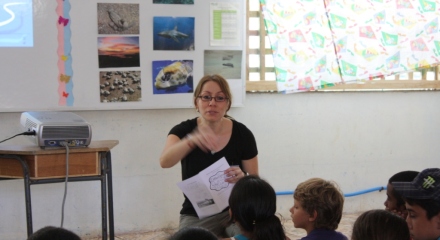
Community outreach education

ARCAE’s environmental and educational objectives include:

Develop and implement research projects that gather baseline information on water quality, endangered marine species activity, and fishing effort in the Golfo Dulce

Promote the protection, defense, restoration, and management of Southern Costa Rica’s coastal resources

Contribute to sustainable coastal development through responsible fishing and sustainable tourism projects

Realize actions targeted at cultural interchanges that promote the acquisition of abilities, attitudes, and practices, leading to new educational and professional opportunities

Contribute to the development of integral members of society through the  improvement of educational systems in the country’s southern, rural, coastal areas      

ARCAE is using various species of endangered sea turtles as the flagships for environmental protection, education, and sustainable economic development.  Its inaugural coastal conservation project is titled: Endangered hawksbill and green sea turtle activity in an approved aquaculture site, mouth of the Golfo Dulce, Costa Rica. 

Sea turtle spotted on surface

In 2008, a tuna aquaculture project, or tuna farm, was given governmental permission to establish its operations near the mouth of the Golfo Dulce (SETENA, 2008).  Anecdotal evidence from artisanal fisher folk shows that endangered green and critically endangered hawksbill sea turtles inhabit this area.  An industrial aquaculture project in the area would conflict with Costa Rica’s commitment to protecting turtle populations, and has the local eco-tourism and artisanal fishing sectors concerned over its possible effects on the economy (watch the YouTube video on the tuna farms).  Determining the presence of turtles in this area will better define the possible environmental impact that the project might have on the area.

ARCAE’s sea turtle research/community outreach project will contribute to the local grass roots effort to stop the tuna farms by:

      • Gathering scientific data on the presence of endangered sea turtles in and around the proposed tuna site, by and legally protect the Golfo Dulce’s mouth
      • Educating local children and adults about the importance of environmental protection
      • Supporting the local initiative to establish a marine protected area for this part of the gulf

ARCAE is sponsored by the London based Rufford Small Grants Foundation

          ARCAE has a dedicated board of managers including experts in environmental conservation, sustainable development, education, public relations, and accounting.  They join together in thanking

The Rufford Small Grants Foundation

            for providing initial funding for this project. 
            If you would like more information on this initiative, including ways you can participate and support it, please contact Andy Bystrom at  abystrom1@yahoo.com and/or Ingrid Rojas at

irojas07@hotmail.com

Posted by: Andy Bystrom | March 9, 2011

Costa Rican artisanal fishers in spotlight

The National Geographic/Ashoka Changemakers award winning artisanal fishing project was recently featured on Costa Rica’s Channel 11 national news. 

The project Development of economic partnerships between artisanal fisher folk and tourism operators (designed by Andy Bystrom for the non-profit PRETOMA) is building economic partnerships/opportunities between artisanal fisher folk and the tourism sector by promoting the development of small, locally owned enterprises dedicated to the marketing and sale of certified, sustainably caught products to local hotels/restaurants.  The project is contributing to natural resource conservation, economic growth, and cultural preservation.  Watch the newscast:

Older Posts »

Categories

Follow

Get every new post delivered to your Inbox.

Join 32 other followers